[ December 2018 – A trip that wasn’t on my bucket list ]
The Greek patient was a chatty one. He had been rolled into the infusion center in a wheel chair by a black woman who seemed to be neither his wife nor daughter nor a friend, or why would they share so much introductory news about each of their lives? Their conversation circled mostly around her hardships. The parents who passed away when she was a child, their various illnesses and her worry about inheriting them, the grandmother who raised her, and her current life of long hours of work, double-shifts, to save up money for her daughter. It sounded as if she was paid to sit there with him, employed by an agency to accompany cancer patients. He listened with great interest, clearly enjoying the socializing. I noticed him looking in our direction as if to invite us into the conversation. Very discreetly though, no obligation to comply with his wishes. I was busy listening to a podcast and distracting myself from the growing pain of platinum salt shooting up my left arm. But when my nurse switched me to the second chemo infusion, he couldn’t hold back any longer: “So you are getting Avastin? How is it working for you?” I admitted that it was my first time and that I couldn’t tell yet. He nodded and continued from his side: “I have a brain tumor. It was big and pushed on areas in the brain, so my legs got paralyzed. Then I got Avastin and my tumor shrank and I can walk again.” I remembered that I had seen him walk to the bathroom, very slowly and with a cane. “Poor guy,” had been my thought half an hour earlier. Now I couldn’t believe how lucky he was to be able to walk again. “This is really good news,” I said to him, “Your story makes me feel very optimistic.”
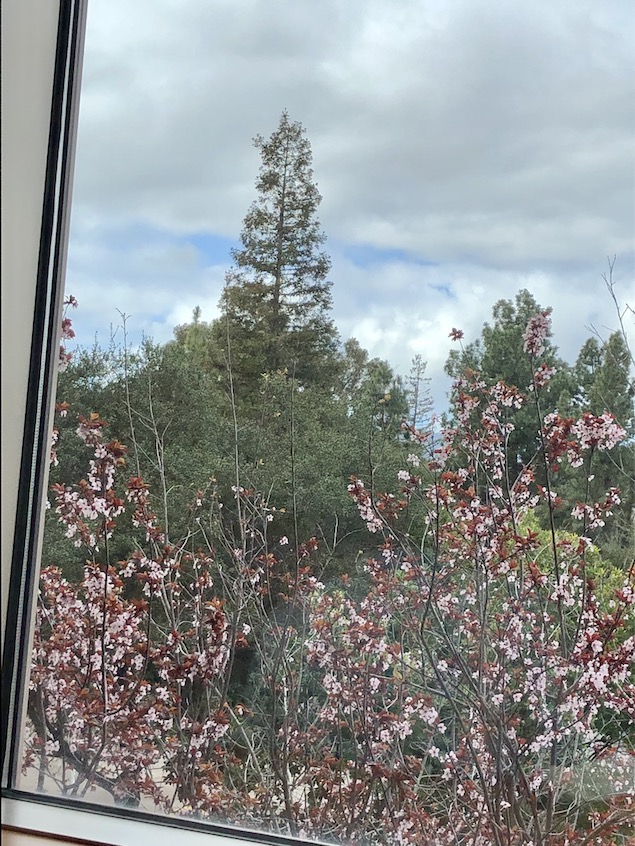
We both had been offered the infusion seats at the window. They came with a view of tree tops and the sky. Did the architect have this in mind when locating the infusion area on the second floor? The infusion team certainly did their best to make the chemo appointment a pleasant experience. There was a cheerfulness in the air, and you were guided to your seat by a welcome host in hospital scrubs who presented the options to help you decide: “We have these more private rooms that come with a bed and a sliding door,” he explained while pointing to the left and right of the hallway, and once he reached the end, he gestured: “And here is our open floor seating area. Our patients find these reclining arm chairs very comfortable. And then over here is the bathroom.” Like in a restaurant, it paid to come early to have a choice. The combination of hallway with private rooms (no window) and open seating (with a view) repeated five times within the infusion center, each section connected to the next by a door frame. For some reasons, the hospital called these sections euphemistically “pavilions”, so officially I was seated in Pavilion C. To me, it sounded a little bit like getting invited to a tea party and hearing your host say: “We’ll have our tea in the rose garden today.” Maybe next time, I’ll have my tea in the winter garden, or, as they call it at the hospital, Pavilion D.
Under the panorama window, the interior designer had combined the pleasant with the practical and installed a long bench where infusion patients could seat their accompanying guests, and under the long bench four oversized drawers where the infusion staff could store pillows and pillow cases. This mixed-use area turned out to be incredibly busy as there always seemed to be a need for yet another pillow or pillow case. Very quickly, the pillow inventory of the two middle drawers depleted and the infusion welcome hosts opened them in vain and then had to ask the infusion patient’s guests to move out of the way to open the side drawers and, very naturally, the pillow inventory of the side drawers went down as well. As this cycle repeated, we eventually reached a state where there were no pillows left, and the activity turned into a funny opening and closing of empty drawers, and infusion staff apologizing to infusion guests, and infusion guests, having learned the drill, just moving out of the way when somebody came close to the window looking like they needed a pillow, and nobody ever thinking of bringing new pillows. Or maybe everybody thinking of it, but nobody acting on it, and certainly nobody ever saying anything like: “Don’t you guys ever think of refilling the drawers?” or “Why did I come here again in vain?” or “Where the heck is the supply manager?” We all became part of the spectacle, enjoying our role in this absurdist play, hoping it would never end and we would never have to come back to reality.
But of course, there was a time when I needed to use the bathroom, and reality kicked back in. The platinum salts started to show their side effects, my hands and feet were cramping and I became incredibly sensitive to cold. Not cold as in ‘I am cold’, but cold as in anything cold that touched me would hurt like a thousand needles. The interior designer who came up with the idea of infusion seats with a view and the mixed-use area of bench and drawer under the window, had probably never heard or thought of this odd side effect. To enter the bathroom, you had to touch a metal handle, and to wash your hands, you had to use cold water, both of which were not an option for me. Maybe taking our tea in the rose garden was not such a good idea after all. Maybe using pavilion to label a hospital section was just wrong and emotionally misleading. I was in a hospital after all, and sick enough to get chemotherapy, and a view from a reclining chair was not my first priority. I could ask somebody to open and close the door for me, but I had to wash my own hands. Out of desperation, I tried the antiseptic foam instead, but apparently I was not just sensitive to cold, but also to alcohol or whatever hospitals offer their staff to get their hands germ-free. I found a sink outside the bathroom with foot pedals that offered cold and hot water. I had to run the water for a really long time to reach an acceptable level of lukewarm and wash the antiseptic foam of my hands and stop the hurting. After that incident, I started joking about how some people had gold teeth. but I could show off my platinum veins. and how this infusion would turn me into a terminator, but in reality I was longing to go back into the absurdist pillow spectacle.
This was until I noticed the elegant lady who was seated at the back wall. She was maybe in her late sixties and her outfit was all color-coordinated in shades of orangey-brown and topped off by a hat of enormous size, at least compared to her tiny figure. It was not a hat you would expect for tea time in the rose garden, but rather a hat inspired by the outfit of paperboys of the times when newspapers were sold by boys on the street. So, the correct label would probably be cap and not hat, but since we happened to be in a place that emphasizes linguistic pleasantness, let’s not become sticklers for words. Just believe me when I say that this woman’s aura of elegance filled the space of open seating and reached me when I was trying so hard to be funny. Dress up for the rose garden, and it will come to you. It was such a pleasure to watch her. At the end of her treatment, the host stopped by and asked if there was anything else she wished for, and with her impeccable manners, she ordered a cup of coffee, just this much coffee and this much water on top. So simple and so beautiful.
Next, a very ill woman in her forties entered as if she were at Starbucks. In her left hand, she was holding a to-go cup, in her right hand, a phone. She was seated at the window in the chair facing me which had been vacant since the Greek patient had left. She offered her guest the bench under the window, and then started a long phone call that she had to interrupt (but not end) a few times when the nurses came by to get her settled. Their exchange about hooking up her breathing tubes to the hospital’s oxygen supply was as casual as you’d ask for the wifi password. From the phone call, we were able to learn her history as a patient: She had cancer in every part of her body, had gone through years of treatment, on and off, and genetic tests had shown her to be predisposed to all kinds of types of cancer. And there she was, sitting in her Lake Tahoe shirt and her casual pants, sipping her beverage, chatting away, and nothing in the world seemed to disturb her routine.
When a beep indicated that my second infusion was done, I couldn’t believe it was already over. After half a day of sitting, I wanted to get up for a walk, but I didn’t really feel like leaving this place that invited me in for a few strangely pleasant hours. It might not be a rose garden, possibly not even a pavilion, but it was certainly more than just a plain section of a hospital. How did they pull this off? What was their magic? Will we ever find out? Shhh, don’t ask, don’t jinx it.
 California Journal